

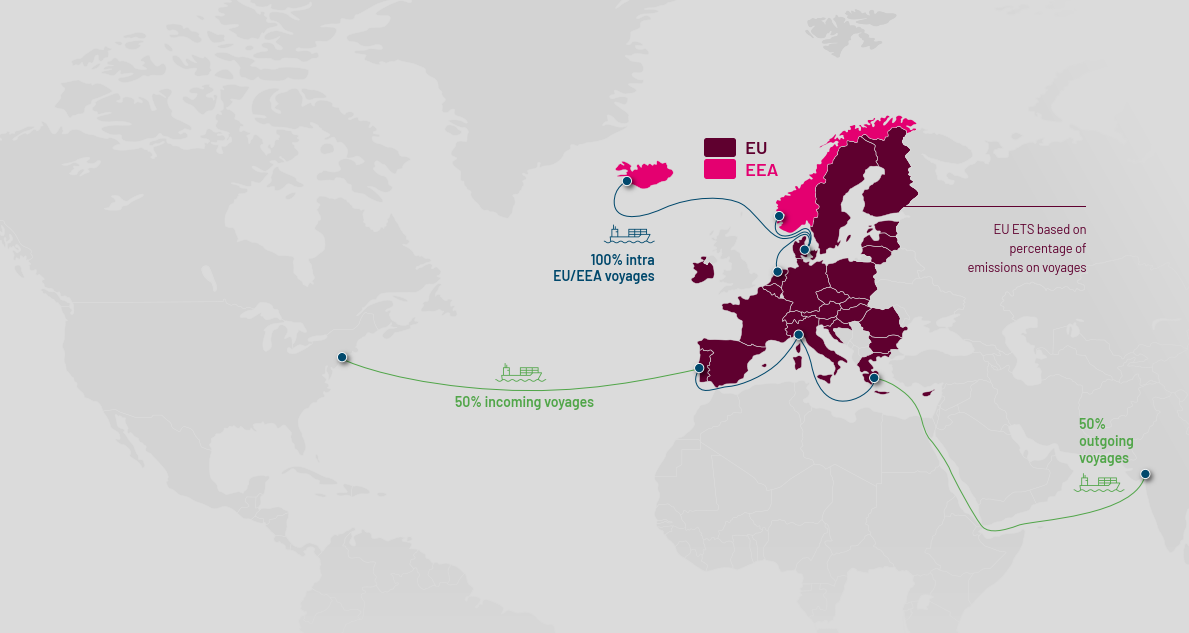
EU ETS – The General Picture in EU
The EU’s emissions trading system is a “cap-and-trade” market designed to reduce greenhouse gas emissions by putting a price on carbon pollution.
The main system is the European Union Emissions Trading System (EU ETS), launched in 2005. It is one of the world’s largest carbon markets.
Here’s how it works:
- A cap is set
The EU sets a limit (“cap”) on the total amount of greenhouse gases that covered industries can emit each year. The cap gradually decreases over time. - Companies receive or buy allowances
Each allowance permits emission of 1 tonne of CO₂-equivalent gases. Some allowances are auctioned; some sectors receive free allocations. - Trading happens
Companies that emit less than their allowance can sell unused permits. Companies exceeding their limits must buy extra permits or face penalties. - The carbon price creates incentives
As allowances become scarcer, their market price usually rises. This encourages:- cleaner technologies
- energy efficiency
- renewable energy investment
- lower fossil fuel use
- The EU ETS mainly covers:
- Power generation
- Heavy industry (steel, cement, chemicals, etc.)
- Aviation within Europe
- Maritime transportation (from 2026 the EU ETS will include emissions from methane and nitrous oxide)